Security that follows the data — not just the traffic.
One policy engine and one detection stack, inline on every AI call. We inspect and control the data itself — on the request going out and the result coming back — across the agents you run and the employees using AI.
One policy engine on every path AI takes.
Whether the actor is an autonomous agent or a person, the same validated detection runs under one policy engine — on the request going out, and the result coming back.
Discover. Enforce. Audit.
Six capabilities on one data path — each one working on the real content, with a reason you can hand an auditor.
Control the request. Inspect the result.
On the way out, BlueAspen controls what an agent or a person can reach — which tools, MCP servers, models and apps, and what data can go with the call. That's the half most tools stop at.
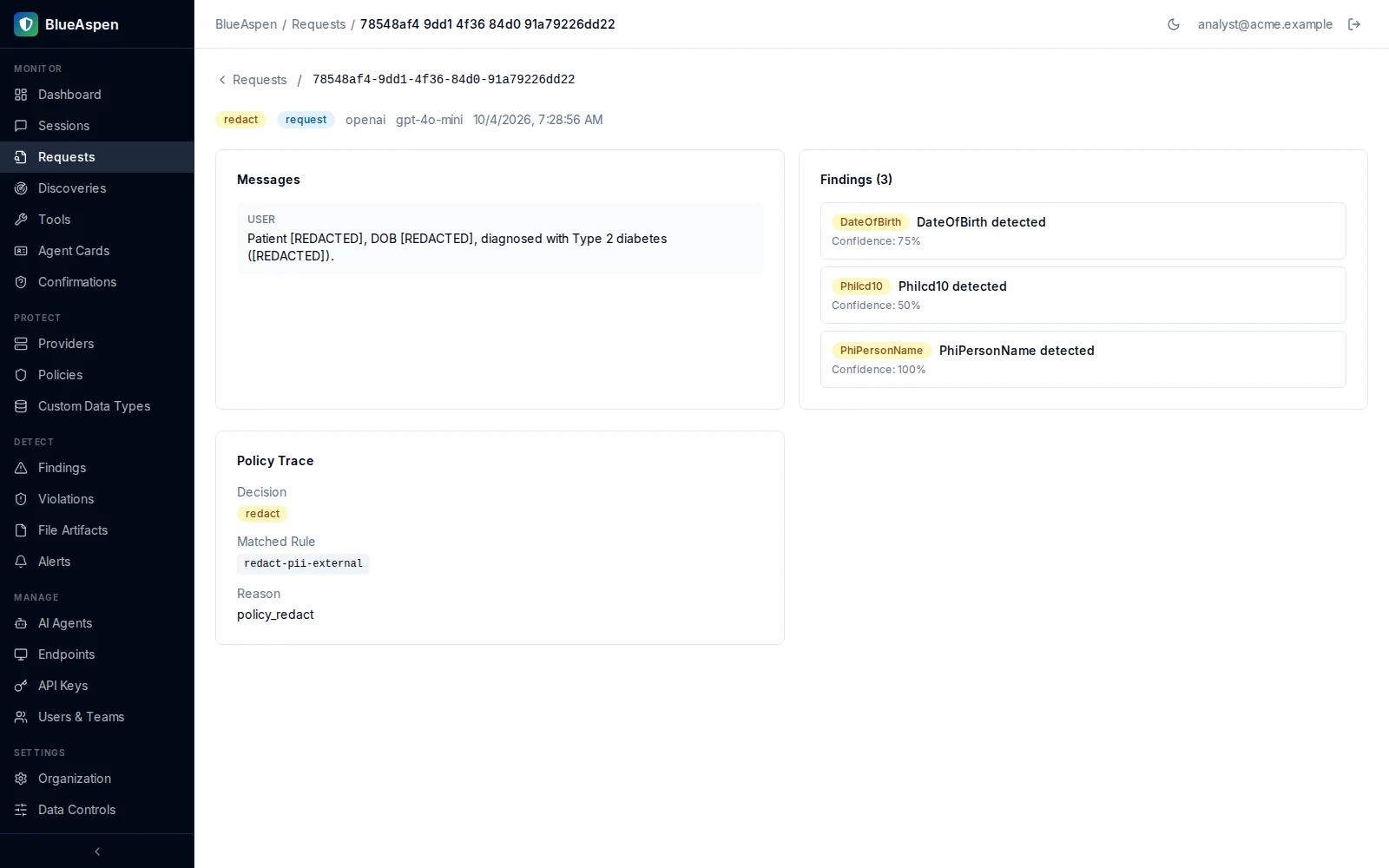
The sensitive part is usually in what comes back. So BlueAspen inspects the result leg too — a tool response, a model answer, an agent reply — and redacts a card number, an SSN or a patient record in place, before it reaches the model, the agent, or the person. The reply stays valid, so the AI keeps working.
Every agent, its own identity.
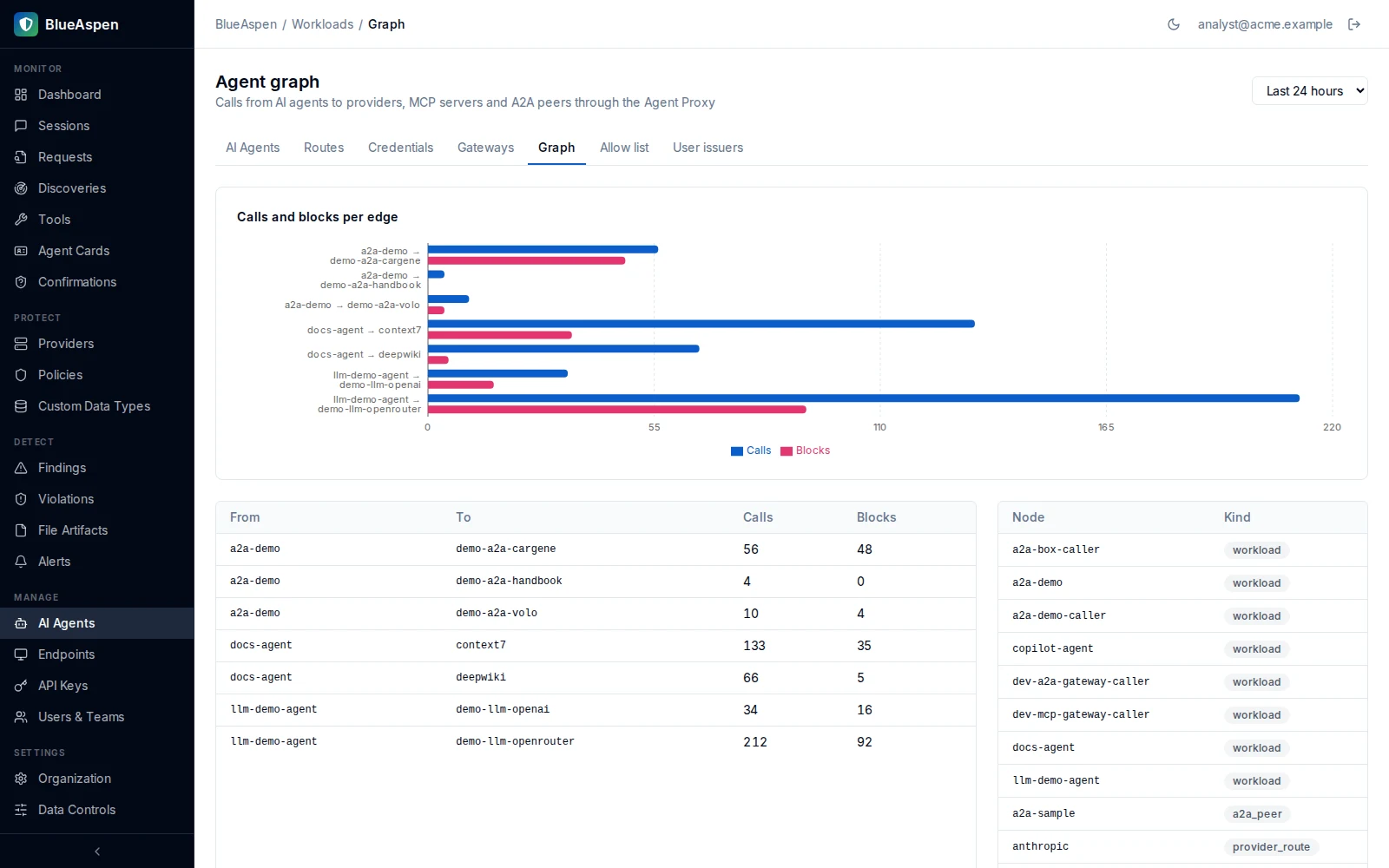
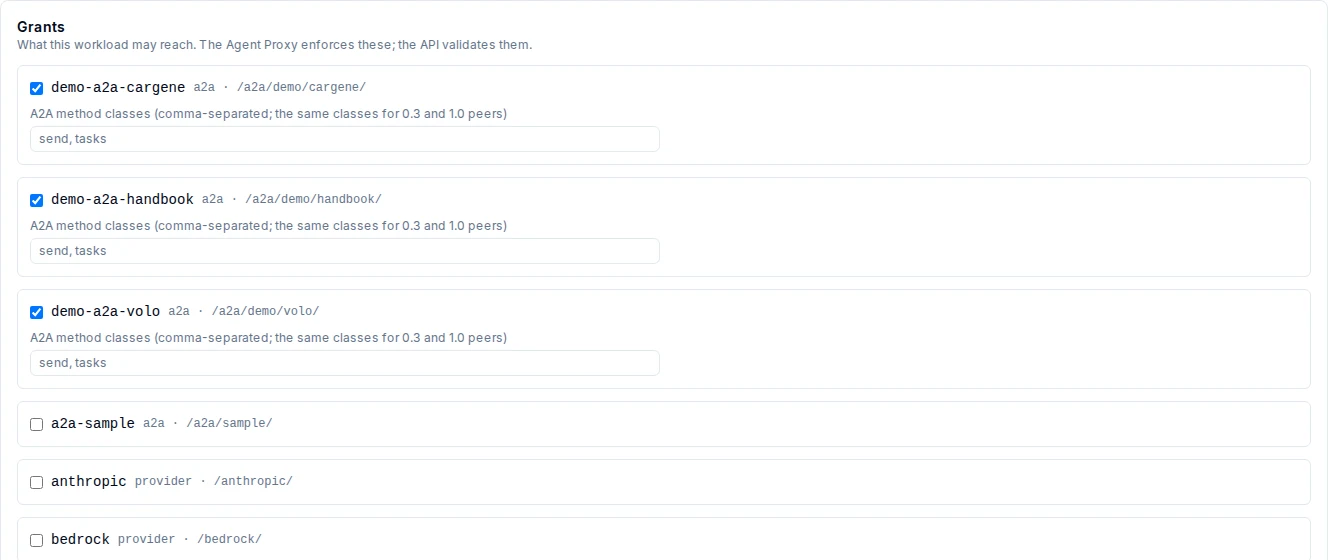
Each agent you run — on a server, in a container or in CI — calls with its own workload identity, so every call names the agent that made it. Grants are default-deny: an agent reaches only the MCP servers, models and agent-to-agent (A2A) peers it was granted, and only the methods it needs.
A2A traffic is screened in both directions. Outbound, a partner agent's card — the profile that says who it is and what it does — is pinned when you approve it; if it changes, calls stop until someone reviews it. Inbound, the hosted A2A gateway shows callers only your approved card, checks every caller's token, and refuses a call it can't judge.
Validated, not guessed.
A regex matches a shape; a validator proves it. BlueAspen runs the real check digits — Luhn for cards and NPI, ABA for routing numbers, mod-97 for IBAN, Shannon entropy for secrets — across 60+ context-scored patterns. A finding is defensible, and a non-match isn't a false alarm.
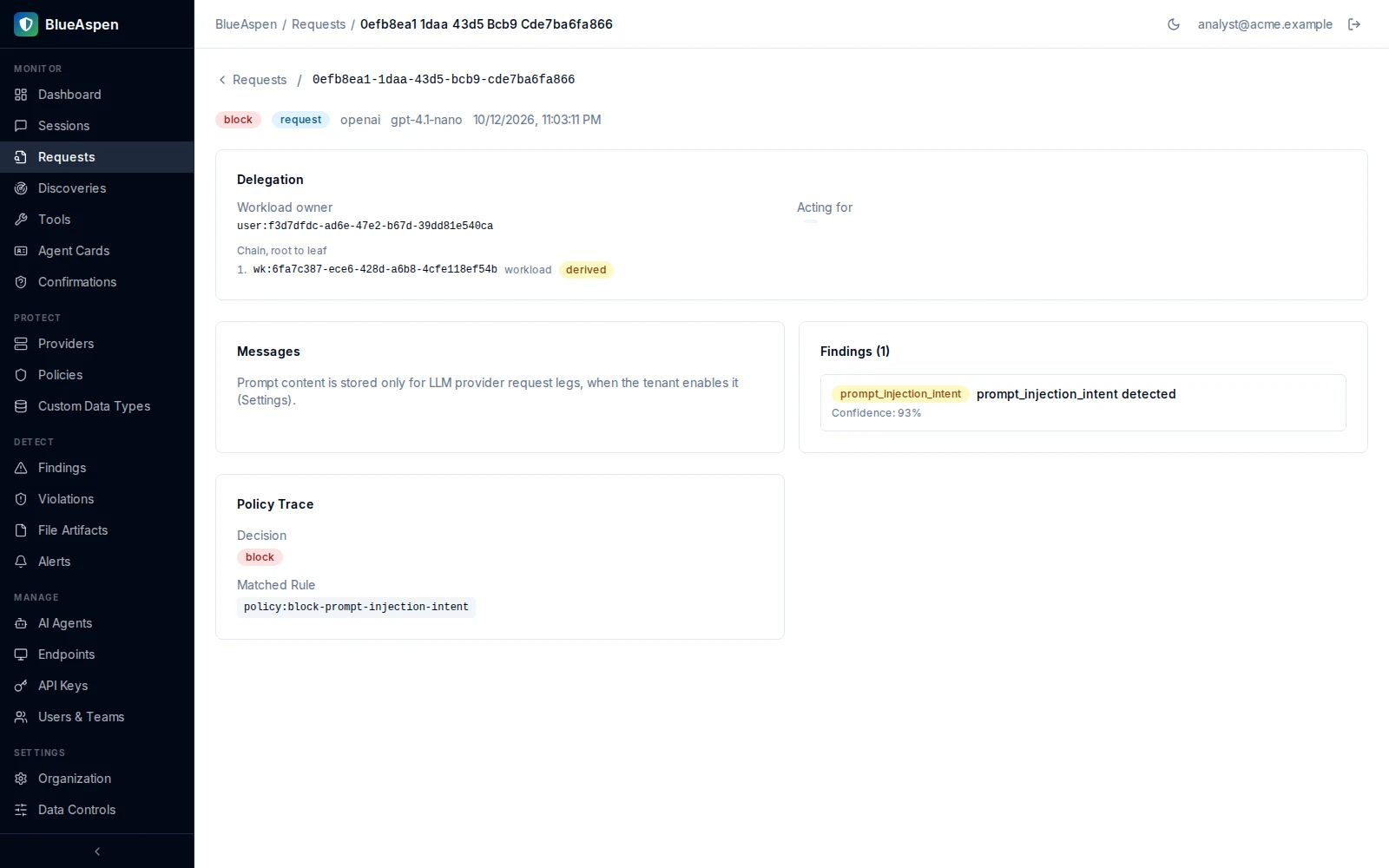
Decided at the call, not in a report after.
“Runtime” is the mechanism, not a dashboard. The policy is evaluated inline, at the moment the call is made — so the decision and its evidence exist when the data moves, not in a report assembled weeks later.
Where it guards data, BlueAspen fails closed: on ingress and agent-to-tool paths, a call it can't judge never reaches the data, and a misconfigured gateway refuses to start. The employee egress proxy fails open by design — security should never block someone from working.
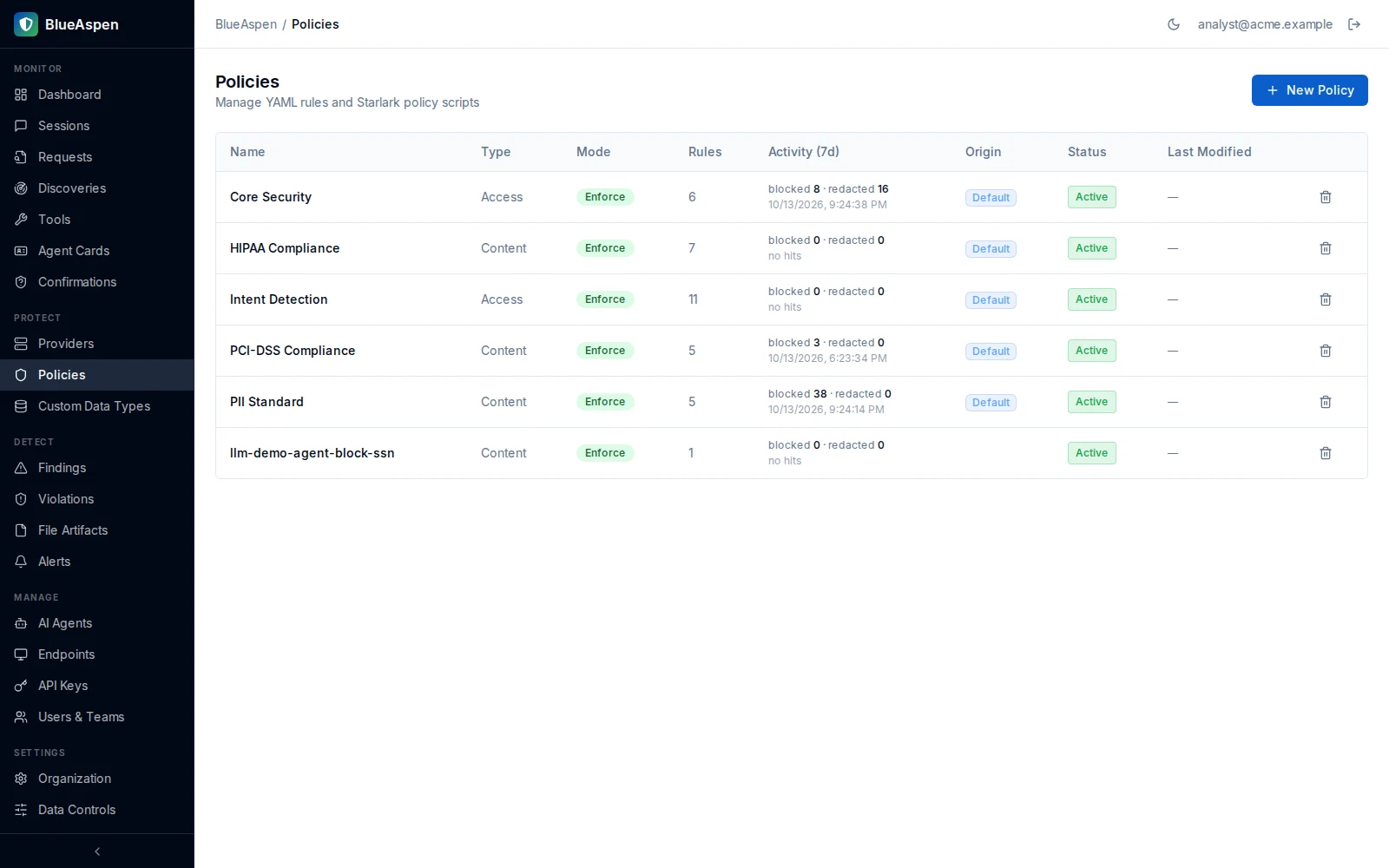
Find what's undeclared.
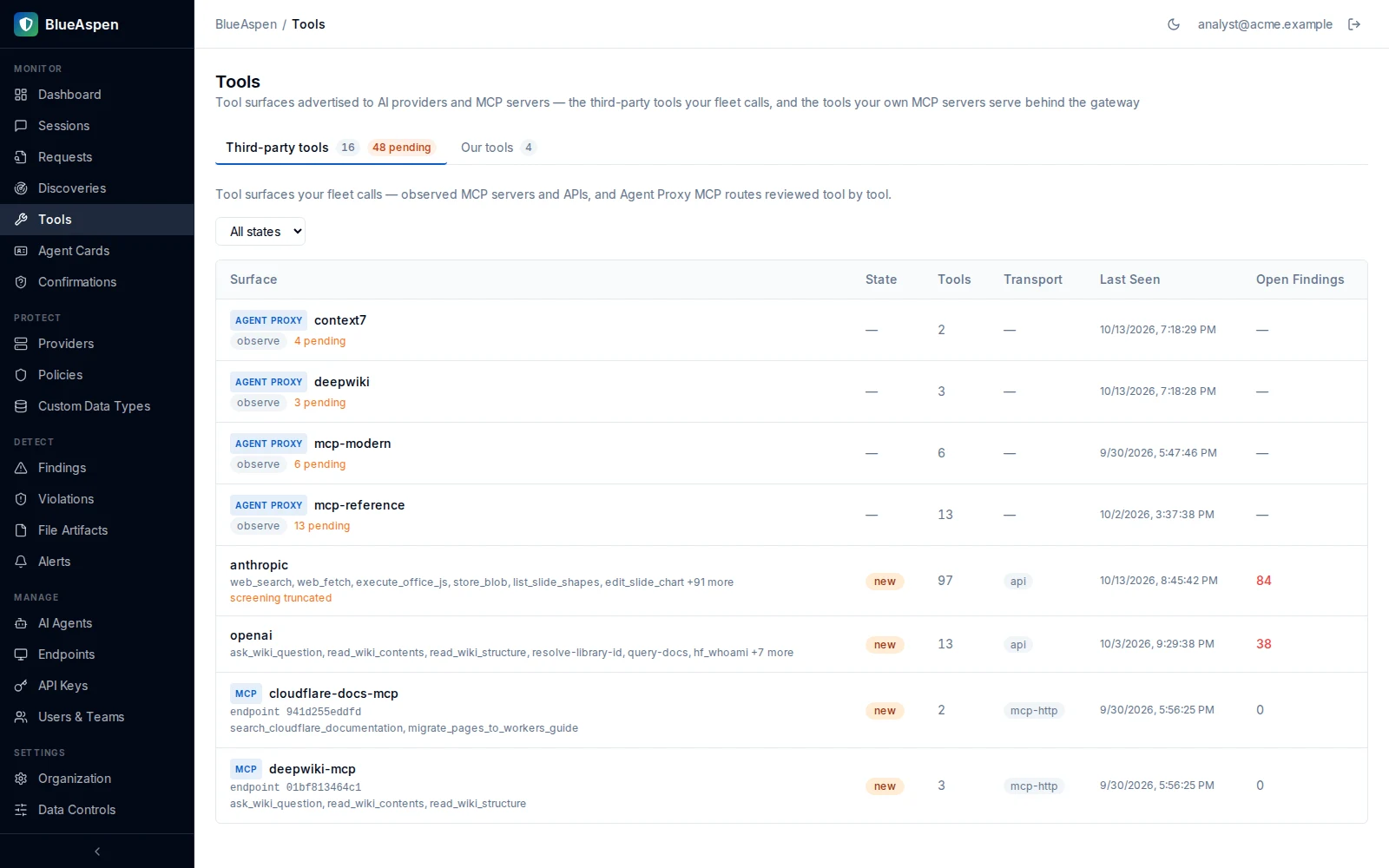
You can't protect data moving through an agent, an MCP server or an AI app you don't know exists. BlueAspen surfaces them from the traffic itself — mapped by the surface they run on — including the shadow ones no registry knows about.
Across the employee surface, that's 40 AI providers and a catalogue of roughly 6,000 AI domains. Registries only cover what someone remembered to declare; BlueAspen shows what's actually in use.
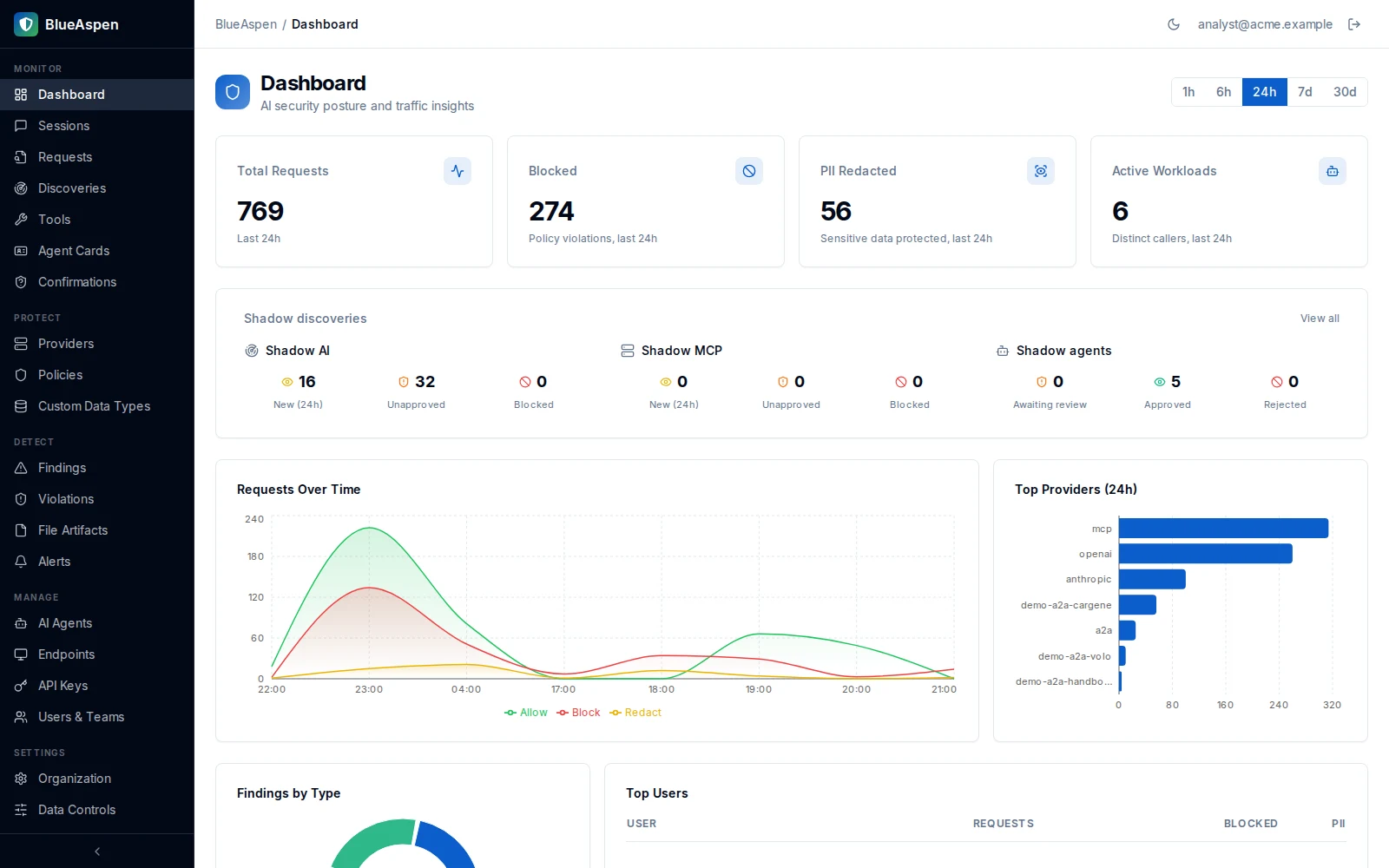
An audit trail you can show a regulator.
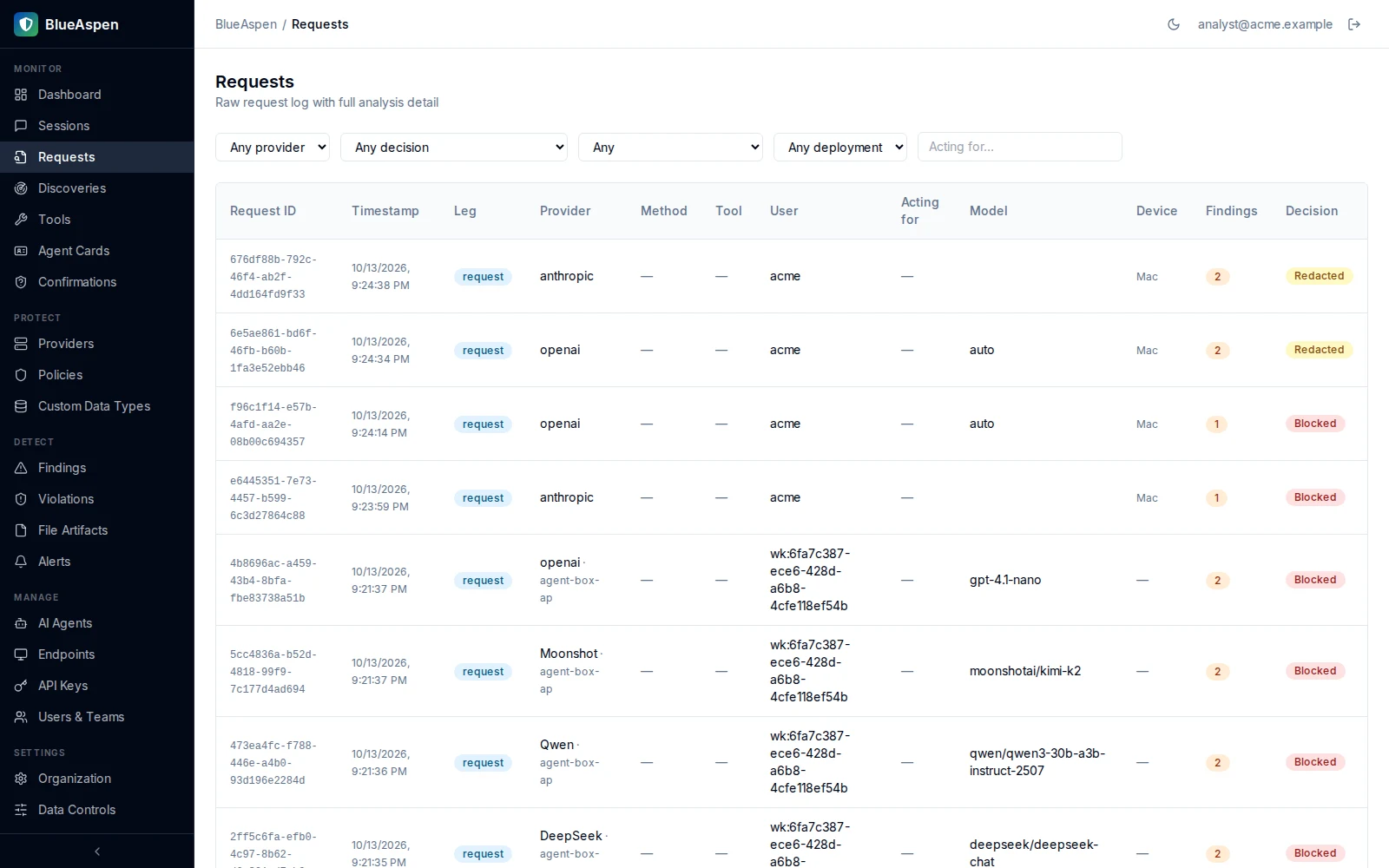
Every decision is recorded with its finding and the reason it fired — what was detected, where on the path, and what BlueAspen did about it. It detects PHI, PCI, PII and secrets, so the record maps to the data a regulated team already has to account for.
12 analyzers run on local ONNX models, so by default no customer data is sent to a third-party LLM to produce that evidence.
We complement your stack — we don't replace it.
Your AI gateway & DLP / CASB
Route and log what AI does.
- Routing, fallbacks, cost control, caching, quotas
- Access, observability, request logging
- DLP on files, web and email
- Keep all of it — it's not our job
BlueAspen
Inspect and control what the data does.
- Validated DLP on the result leg, redacted in place
- Fail-closed on ingress — a call we can't judge never reaches your data
- Inside MCP, A2A and model traffic — where DLP/CASB can't reach
- Discovery of undeclared agents, MCP servers and AI use
Deploy BlueAspen alongside the AI gateway and the DLP/CASB you already run — on the data path, where they don't reach.
Two budgets, one control plane.
Two entry points into the same account — land on whichever surface is on fire, expand to the other on the same engine.
Stop regulated data leaving through AI.
See where AI reaches regulated data and what it brings back — and prove it. A leaked AI interaction is a reportable breach, not a dashboard metric.
Put agents in front of data, safely.
Control what your agents can reach over MCP and A2A, and redact what tools and models return — without rewriting the agent or breaking the protocol.
Evidence, not a policy doc.
A reason on every finding and an audit trail that maps to PHI, PCI, PII and secrets — enforced at the call, not written down and hoped for.